Showing posts with label queer. Show all posts

Tuesday, September 23, 2014

It’s Bisexual Awareness Week! Here Are Five Ways To Celebrate

feature image via thenextgreatgeneration.com
Bisexual people make up more than 50 percent of the LGB community, but media, the mainstream, and even LGBT groups often erase our experiences and specific needs or fold them into lesbian and gay programs and statistics. BiNet USA, GLAAD and other organizations hope the first ever Bisexual Awareness Week will be a step toward making more space for for the B in LGBT.
September 23, 1999 was the first Celebrate Bisexuality Day, and in that tradition a big part of the week aims to celebrate what makes bisexuality and bisexuals great, and honor our accomplishments throughout history and today. Organizers also want to make people aware of the stark realities non-monosexual people face, like poorer health, higher rates of sexual assault and relatively low rates of being out as bisexual — only 28 percent of bi people say they are out to the most important people in their lives, compared to more than 70 percent of gay and lesbian people.
“Bisexuals are coming together to say we can’t live with this anymore,” said Faith Cheltenham, the president of BiNet USA. “Because we haven’t been living with it — there have been a lot of suicides. I’ve lost three friends in this work since I started doing it because they had no hope.”
Bisexuals have successfully worked together to gain more visibility and pursue proactive policies and services in recent years. There are many ways to celebrate and honor Bisexual Awareness Week. Here are a few! Add your own in the comments.

1. Educate yourself about the specific challenges of bisexual people and support efforts to improve our lives.

A new report from the LGBT Movement Advancement Project uses data to demonstrate the ways in which bisexual people face specific challenges and thus require targeted solutions. The report collates a lot of data that has been widely shared and discussed on this website and many other places — and that’s because there simply isn’t much reliable data on bisexuals, said Heron Greenesmith, a movement and policy analyst for LGBT MAP. It’s startling and important to see so much data collected in one place. The report highlights poor physical and mental health among bisexuals compared to heterosexual, lesbian and gay people; higher levels of poverty; and higher rates of intimate partner and sexual violence among bisexual women.
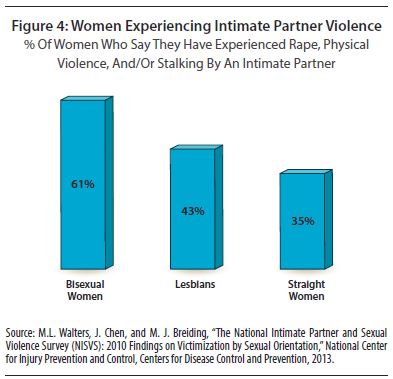
via LGBT Movement Advancement Project
This report gives the media, service providers and bi people a comprehensive place to go to look for information and statistics about bi people. Says Greenesmith:
I’m hoping that media will use it and all the resources collected during the week to speak more competently about the LGBT movement and understand that even the LGB part is not a monolith. I’m hoping LGBT organizations will see it as an invitation to showcase their bi-specific programming and for those who don’t have any to understand the necessity and the importance of having bi-specific programming. I’m hoping that bi folks will see it and know that not only are they not alone but other people are going through the same challenges they are facing in their lives and folks are out there who are supporting them. I’m hoping that service providers and researchers will take it as an invitation to be more culturally competent and precise in their language around LGBT people and in their work.
The research presented demonstrates why it’s harmful to fold bisexuals in with gays and lesbians or heterosexual people when doing research and providing services. For example, Cheltenham noted that many LGBT-oriented health centers can’t or won’t provide bi-specific health care and may even turn away bisexual patients. The lack of information and awareness has very real consequences. As Greenesmith said, there is a dearth of research on bisexuals, and not much of what does exist accounts for the intersections of oppression that put some bisexual people, like those who are transgender, gender nonconforming or non-binary, of color or low-income at greater risk. With more knowledge, policymakers and service providers can better target their work to reach the most people and improve outcomes for bisexuals and everyone in the larger LGBTQ community.

2. Read and share books about bisexuality.

I semi-regret getting the incredible Bi: Notes From A Bisexual Revolution by Shiri Eisner on Kindle because it makes it harder to foist it upon people and make them read it. Before I read it, I was timid about identifying as bi because I felt like it carried baggage I wasn’t prepared to handle. After reading Eisner’s book, I became excited and proud to call myself bi (in addition to queer) and quote it at anyone who will listen. Now I’m making my way through Getting Bi: Voices of Bisexuals Around The World, an anthology of more than 200 essays from bisexual people from 42 countries who speak from many different experiences of gender, race, class and more. Its editors, Robyn Ochs and Sarah Rowley, are among the most trusted and active bi women in the U.S. and internationally. Next up on my list is Bisexuality and Transgenderism: Intersexions of the Other. It’s a textbook, so it’s expensive and hard to track down, but it is an important resource for people interested in the ways bisexual and transgender identities, movements and oppressions overlap and diverge. Because bisexuals are often erased in mainstream works about lesbian and gay people, bisexuals are creating our own texts, with many awesome results.

3. Donate to organizations that support bisexuals.

Although bisexual people make up a very large portion of the LGBT community, funding for bi-specific work makes up a small part of funding for LGBT programs. If you’ve got extra dollars floating around, put them toward the work of improving quality of life for bisexual people. National organizations like BiNet USA and Bisexual Resource Center are collecting resources, energizing communities and working directly with LGBT and mainstream leaders to promote bisexual causes and get information into the public. Find out if your local LGBT resource center provides bi-specific programming and give a donation marked for that program. Become an A+ member to help financially support the bisexuals who work at this website, and so you can read our staff emails where we finally explain bisexual orgasms (hint: they involve ghosts).

4. Engage with people online and in real life about bisexuality.
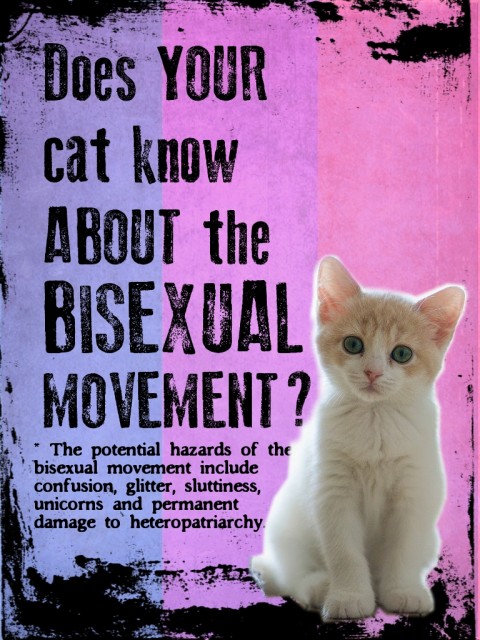
Cats are like "I always knew I was different but didn't have the words to express it before." via bidyke.tumblr.com
Cats are like “I always knew I was different but didn’t have the words to express it before.” via bidyke.tumblr.com
BiNet has a series of hashtags for the week to highlight different aspects of the bisexual movement, which you can find on their site. The hashtags so far — #bihistory and #bifacts — have provided some amazing insights and resources, so check them out on the twitters and contribute! There are also a ton of official events, like meetups, trainings and concerts, plus online activities like a Google Hangout with bisexual Christian heartthrob Eliel Cruz hosted by Campus Pride. If none of that is your bag, just paint your face blue, purple and pink and go to brunch.

5. Acknowledge and celebrate bisexuals and bisexuality.

It seems so simple, but it often doesn’t happen. Bisexuals are often an afterthought, lumped in with bigger headings like gay, queer and LGBT without being named as our own community with specific needs. Subtle changes to daily language — the simple act of naming bisexuality and actively including bisexual people and concerns in activism, policy language and service provision will make an impact. The fight is so much bigger than visibility, but reversing the damaging impact of erasure and silencing is an important first step toward caring for bisexual people and communities. Some people aren’t comfortable with using the term bisexual for themselves or as an umbrella term, and all these suggestions apply to people of many non-monosexual identities.
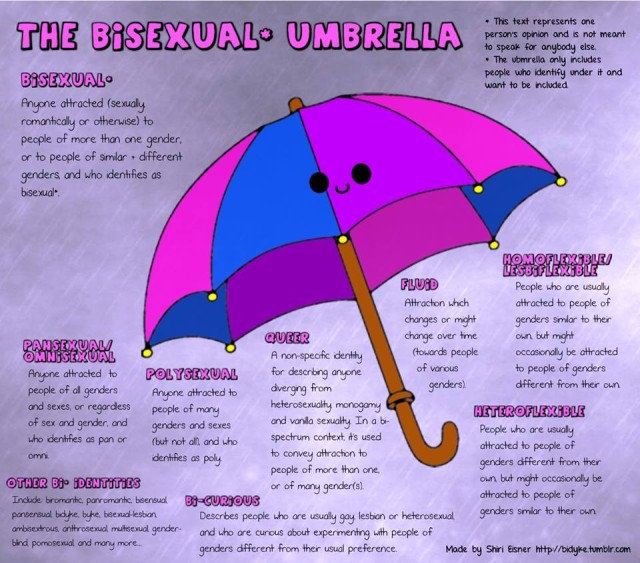
bisexual umbrella
Bisexual Awareness Week is about more than awareness — it’s a chance to loudly declare our presence in the LGBT community and the world and work for the rights, respect and services that will keep us alive and help our community become healthy and vibrant.

Friday, February 10, 2012

Cynthia Nixon Update: I Don’t Identify as Bi Because Nobody Likes Bisexuals

Posted by Kevin Farrell on Jan 24, 2012 in Real Talk

Perhaps sensing some frustration (and a twinge of outrage?) from the LGBT community over her comments about choosing to be gay, Cynthia Nixon spoke with The Daily Beast’s Kevin Sessums for a quickie follow-up interview.

Sessums, like the majority of our readers, posits that if Nixon truly possesses the ability to choose between being gay and being straight, then isn’t she really bisexual? And wouldn’t that then mean she didn’t actually have a choice in her sexuality after all?

KS: You’ve been very vocal and political about marriage equality and helped lead the successful fight for it in New York. So congratulations on your own marriage. But before you met and fell in love over seven years ago now with Christine—who, through a sperm donor, gave birth to your son Max Ellington almost a year ago—you were in a 15-year relationship with Danny Mozes, whom you first met in high school. You had two children with him—Samantha, who is now 15, and Charles Ezekiel, who is 9. You’ve been quoted as saying about these two relationships in your life: “In terms of sexual orientation, I don’t really feel I’ve changed … I’ve been with men all my life and I’d never fallen in love with a woman. But when I did, it didn’t seem so strange. I’m just a woman in love with another woman.” I’m a bit confused. Were you a lesbian in a heterosexual relationship? Or are you now a heterosexual in a lesbian relationship? That quote seemed like you were fudging a bit.

CN: It’s so not fudging. It’s so not. I think for gay people who feel 100 percent gay, it doesn’t make any sense. And for straight people who feel 100 percent straight, it doesn’t make any sense. I don’t pull out the “bisexual” word because nobody likes the bisexuals. Everybody likes to dump on the bisexuals.

KS: But it is the “B” in LGBT.

CN: I know. But we get no respect.

KS: You just said “we,” so you must self-identify as one.

CN: I just don’t like to pull out that word. But I do completely feel that when I was in relationships with men, I was in love and in lust with those men. And then I met Christine and I fell in love and lust with her. I am completely the same person and I was not walking around in some kind of fog. I just responded to the people in front of me the way I truly felt.
Yikes.

Honestly, we can empathize with Nixon and her feelings toward her own sexuality. But this interview just makes her come off worse than before.

Nobody has the right to judge anyone about who they are attracted to – it’s kind of what the LGBT community is fighting for, isn’t it? But we can’t imagine that saying “nobody likes bisexuals” is going to go over very well.

What do you think about Nixon’s comments? Does anybody like bisexuals? Are we all just twisting her words here?
Originially posted at http://unicornbooty.com/blog/2012/01/24/cynthia-nixon-update-i-dont-identify-as-bi-because-nobody-likes-bisexuals/

Reposted for thoughts at http://www.keystothecloset.blogspot.com

Friday, January 27, 2012

Nominations of LGBTQ Youth Activists Invited for Colin Higgins Youth Courage Awards

Deadline: February 29, 2012
A program of the Colin Higgins Foundation, the Colin Higgins Youth Courage Awards annually honor lesbian, gay, bisexual, transgender, two-spirit, queer, and questioning youth who have transformed their experiences with bigotry and discrimination into opportunities to inspire others by taking action, rallying support, building community, and working to change the systems and institutions that impact their lives.

Unlike scholarships based on grade-point average or written essays, the Colin Higgins Foundation looks to communities across the United States to nominate and lift up LGBTQ youth activists who inspire them and play critical roles in their schools, organizations, and community spaces.

Nominations should describe obstacles the nominee has faced due to their sexual orientation and/or gender identity, how the nominee has overcome these obstacles through community-level activism for LGBTQ rights, and how the award could transform the life of the nominee and help them achieve their dreams.

Nominees must be 21 years of age or younger and must be U.S. citizens. Self-nominations are not accepted.

Three award winners will be selected to receive $10,000 each. Awardees also will receive an expense-paid trip to the 2013 National Gay and Lesbian Task Force Creating Change Conference.

Complete program guidelines and nomination forms as well as information on previous awardees are available at the Colin Higgins Foundation Web site.

Contact:
Link to Complete RFP http://www.colinhiggins.org/courageawards/nom_form.cfm


http://www.keystothecloset.blogspot.com

Wednesday, July 13, 2011

BRAVO Contributes to Report on Hate Violence against LGBTIQ Community

BRAVO CONTRIBUTED TO NATIONAL REPORT ON HATE VIOLENCE AGAINST LESBIAN, GAY, BISEXUAL, TRANSGENDER, QUEER AND HIV-AFFECTED COMMUNITIES RELEASED TODAY:
Report shows second highest murder rate ever recorded. Transgender people and people of color are most targeted communities for severe hate violence. Ohio among top states reporting.
To download the full Report please visit NCAVP online.

Columbus, Ohio — The National Coalition of Anti-Violence Programs (NCAVP), in a national audio press conference today, released its report Hate Violence Against Lesbian, Gay, Bisexual, Transgender, Queer and HIV-Affected Communities in the United States in 2010. Buckeye Region Anti-Violence Organization (BRAVO), a member program of NCAVP, saw the impact of severe violence against local LGBTQ and HIV-affected communities.
• Ohio is once again ranked among the top states in the nation in the number of hate violence incidents committed against LGBT people, with 340 such incidents reported in 2010.
• The 2010 data indicates a continuation in the trend of an increase in the severity of violence over the past few years, throughout BRAVO’s service area. That trend continued in 2010, reflecting a steady upward swing in the use of weapons, particularly thrown objects like bottles, rocks and bricks.
Additional key findings and recommendations from the national report include the following:
• In 2010, NCAVP documented 27 anti-LGBTQ murders, the second highest yearly total ever recorded by the coalition. This is a 23% increase from the 22 people murdered in 2009.
• 70% of the 27 reported hate murder victims in 2010 were LGBTQ and HIV-affected people of color, which represented 44% of total survivors and victims. This reflects a disproportionate targeting of people of color for severe and deadly violence. As well, people of color were less likely to receive medical attention when they needed it and less likely to receive appropriate responses from the police.
• Transgender women made up 44% of the 27 reported hate murders in 2010, while representing only 11% of total survivors and victims. As well, transgender people were more likely to have injuries as a result of attacks and less likely to receive medical care.
NCAVP documented a 13% increase in hate violence incidents from 2009 to 2010, as well as a much greater increase in the severity of violence. “The findings of this report are troubling and reveal a need for the serious commitment of organizations, institutions, funders and policymakers towards research and the prevention of violence against LGBTQ and HIV-affected individuals,” said Gloria McCauley from the Buckeye region Anti-Violence Organization. “Our recommendations represent crucial steps for ending violence against LGBTQ and HIV-affected people in this country.”

The report’s specific recommendations include calling for the following changes:
• Fund critically needed research and data collection on hate violence against LGBTQ and HIV-affected communities, their access to services, and violence prevention initiatives.
• Gather data about sexual orientation and gender identitiy in all federal, state and local government forms.
• Create new public and private funding streams and target the use of existing funds to increase access to anti-violence services for LGBTQ and HIV-affected individuals, particularly for those disproportionately affected by hate violence-i.e. transgender people and people of color.
• Create programs and campaigns to reduce anti-LGBTQ hate violence. Prioritize the leadership of those most impacted by severe hate violence within these programs.
• Stop the culture of hate through policymakers and public figures denouncing anti-LGBTQ violence.
This year’s report also includes real-life stories from LGBTQ and HIV-affected survivors of hate violence to call immediate and necessary attention to the need to end the culture of violence in which these incidents of hate violence occur.

BRAVO works to eliminate violence perpetrated on the basis of sexual orientation and/or gender identification, domestic violence and sexual assault through prevention, education, advocacy, violence documentation and survivor services, both within and on behalf of the Lesbian, Gay, Bisexual and Transgender communities.

NCAVP works to prevent, respond to, and end all forms of violence against and within lesbian, gay, bisexual, transgender, queer and HIV-affected (LGBTQH) communities. NCAVP is a national coalition of local member programs, affiliate organizations and individuals who create systemic and social change. We strive to increase power, safety and resources through data analysis, policy advocacy, education, and technical assistance.

Reposted at keystothecloset.blogger.com

Wednesday, May 25, 2011

PBS’s Independent Lens Premiers Documentary on Two Spirits

6/14Event Starting Date: June 14, 2011 6:00 pm

Event Details: Independent Lens: Two Spirits June 14, 2011

Two Spirits interweaves the tragic story of a mother’s loss of her son with a revealing look at the largely unknown history of a time when the world wasn’t simply divided into male and female and many Native American cultures held places of honor for people of integrated genders. Powerful and moving, Lydia Nibley’s Two Spirits explores the life and death of Fred Martinez and the ancient Native American two-spirit tradition. Two Spirits will premiere on the Emmy Award-winning PBS series Independent Lens, hosted by America Ferrera, on Tuesday, June 14, 2011 (check local listings).

Fred Martinez told his mother he felt as if he was both a boy and a girl, and she explained that this is a special gift, according to traditional Navajo culture. But the place where two discriminations meet is a dangerous place to live, and Fred became one of the youngest hate-crime victims in modern history when he was brutally murdered at sixteen. Between tradition and controversy, and freedom and fear, lies the truth—the bravest choice you can make is to be yourself.

Two Spirits explores issues of national concern including the bullying and violence commonly faced by LGBT people, and the epidemic of LGBT teen suicide, and reveals the range of gender expression that has long been seen as a healthy part of many of the indigenous cultures of North America, and of Navajo culture in particular.

Location:
To learn more about the film, and the issues involved, visit the companion website for Two Spirits at www.pbs.org/independentlens/two-spirits. Get detailed information on the film, watch preview clips, read an interview with the filmmaker, and explore the subject in depth with links and resources. The site also features a Talkback section where viewers can share their ideas and opinions.

Monday, March 28, 2011

Dragon Age Writer On Characters’ Bisexuality

I am not at all familair with the world of gaming, but this post was passed on to me. The quote below is not interesting , but the response of the author of the game to the homophobic posting by a player, is well done.

"Homophobic (or at least stridently heteronormative) fans of Bioware's Dragon Age II are upset at the game's omnisexual characters, which offer players romantic dalliances regardless of their avatars' sex. After a player requested a "no homosexuality" option, one of the game's writers let him down firmly but gently. The real problem, of course, is that the romances are played out in game-engine CGI, summed up by QT3's Malcolm Tucker as 'cringe-inducing gamer-stigmatizing Uncanny Valley evoking boner-annihilators.' "

The response:
A peculiar accusation was made against Dragon Age II on the BioWare forums, in which a user accused the game of not properly catering for the straight male gamer. Honestly, I’d launched into writing this with the intention of factually reporting it, but just typing those words has made me want to start throwing chairs. What? Good grief, even if that were true, which it so spectacularly isn’t, wouldn’t it… but… good grief. Amazingly, one of BioWare’s writers, David Gaider, gave a calm, level-headed response where I would have said capital swears. He makes some interesting comments, as EG point out.

In Dragon Age II you’re able to form relationships with your companions. In order to cater for players choosing to play as, or indeed being, male or female, these characters are essentially bisexual. Some are overt about this, others you’d never know until you played again as a different sex. When I finally write my treatise on the game, I will have some criticisms to make of the way relationships are handled, but the variety, and offering of straight, gay and bisexual relationships certainly won’t be one of them.
The original poster said things that make my spine hurt, like,
“Its ridiculous that I even have to use a term like Straight Male Gamer, when in the past I would only have to say fans.”
But the crux of his argument was,
“In every previous BioWare game, I always felt that almost every companion in the game was designed for the male gamer in mind. Every female love interest was always written as a male friend type support character. In Dragon Age 2, I felt like most of the companions were designed to appeal to other groups foremost, Anders and Fenris for gays and Aveline for women given the lack of strong women in games, and that for the straight male gamer, a secondary concern. It makes things very awkward when your male companions keep making passes at you. The fact that a “No Homosexuality” option, which could have been easily implemented, is omitted just proves my point.”
Imagine the news stories if BioWare had included a “no homosexuality” button. Anyway, we’re not supposed to be dragging some guy on a forum over the coals for what some may think are deeply homophobic remarks. Gaider’s reply is the interesting part of this story.
He does point out that it’s a politely expressed ignorant opinion, before going on to criticise the behaviour of others in the (clearly heavily modified) thread. And then offers an eloquent explanation of the decisions made for Dragon Age II’s romance. I’ll paste the whole thing here:
“The romances in the game are not for “the straight male gamer”. They’re for everyone. We have a lot of fans, many of whom are neither straight nor male, and they deserve no less attention. We have good numbers, after all, on the number of people who actually used similar sorts of content in DAO and thus don’t need to resort to anecdotal evidence to support our idea that their numbers are not insignificant… and that’s ignoring the idea that they don’t have just as much right to play the kind of game they wish as anyone else. The “rights” of anyone with regards to a game are murky at best, but anyone who takes that stance must apply it equally to both the minority as well as the majority. The majority has no inherent “right” to get more options than anyone else.
More than that, I would question anyone deciding they speak for “the straight male gamer” just as much as someone claiming they speak for “all RPG fans”, “all female fans” or even “all gay fans”. You don’t. If you wish to express your personal desires, then do so. I have no doubt that any opinion expressed on these forums is shared by many others, but since none of them have elected a spokesperson you’re better off not trying to be one. If your attempt is to convince BioWare developers, I can tell you that you do in fact make your opinion less convincing by doing so.
And if there is any doubt why such an opinion might be met with hostility, it has to do with privilege. You can write it off as “political correctness” if you wish, but the truth is that privilege always lies with the majority. They’re so used to being catered to that they see the lack of catering as an imbalance. They don’t see anything wrong with having things set up to suit them, what’s everyone’s fuss all about? That’s the way it should be, any everyone else should be used to not getting what they want.
The truth is that making a romance available for both genders is far less costly than creating an entirely new one. Does it create some issues of implementation? Sure– but anything you try on this front is going to have its issues, and inevitably you’ll always leave someone out in the cold. In this case, are all straight males left out in the cold? Not at all. There are romances available for them just the same as anyone else. Not all straight males require that their content be exclusive, after all, and you can see that even on this thread.
Would I do it again? I don’t know. I doubt I would have Anders make the first move again– at the time, I thought that requiring all romances to have Hawke initiate everything was the unrealistic part. Even if someone decides that this makes everyone “unrealistically” bisexual, however, or they can’t handle the idea that the character might be bisexual if they were another PC… I don’t see that as a big concern, to be honest. Romances are never one-size-fits-all, and even for those who don’t mind the sexuality issue there’s no guarantee they’ll find a character they even want to romance. That’s why romances are optional content. It’s such a personal issue that we’ll never be able to please everyone. The very best we can do is give everyone a little bit of choice, and that’s what we tried here.
And the person who says that the only way to please them is to restrict options for others is, if you ask me, the one who deserves it least. And that’s my opinion, expressed as politely as possible.”

This quote originally posted at http://www.rockpapershotgun.com/2011/03/25/dragon-age-writer-on-characters-bisexuality/ was refered to in a blog posted by Boingboing.  It was reposted at http://keystothecloset.blogspot.com/.